Problem
Can we predict short-term S&P 500 returns using historical data and macro/market indicators? The goal is to build a practical forecasting model and evaluate whether it adds value over simple benchmarks.
Data
Three groups of inputs, aligned to a daily trading calendar:
| Group | Features | Source |
|---|---|---|
| Price | Daily index close → returns | [Source] |
| Technical | Lagged returns, moving averages, RSI | Derived |
| Macro | VIX, PMI — forward-filled to daily | [Source] |

Approach
- Construct a feature set from price, technical, and macroeconomic data.
- Train and compare several models — Ridge, Random Forest, and XGBoost.
- Evaluate with a walk-forward backtest and risk-adjusted metrics such as the Sharpe ratio.
Results
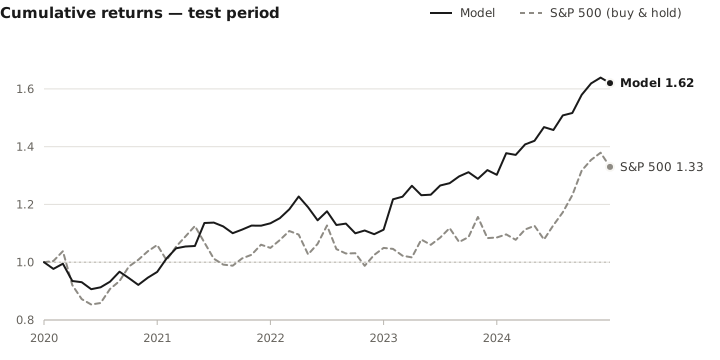
Over the walk-forward test period, the model outperformed a buy-and-hold position in the index on a risk-adjusted basis.
Annual return14.2%
Volatility16.8%
Sharpe ratio0.85
Max drawdown−18.6%
Key takeaways
- The model outperforms a buy-and-hold benchmark on a risk-adjusted basis.
- Feature engineering and regularization are important for stable performance.
What I’d do next
[A short, reflective paragraph — e.g. adding transaction costs, testing regime-aware features — so the page reads like a lesson, not just a result.]